
AI Instructional Design: How Artificial Intelligence Is Changing eLearning Development
Jul 24, 2026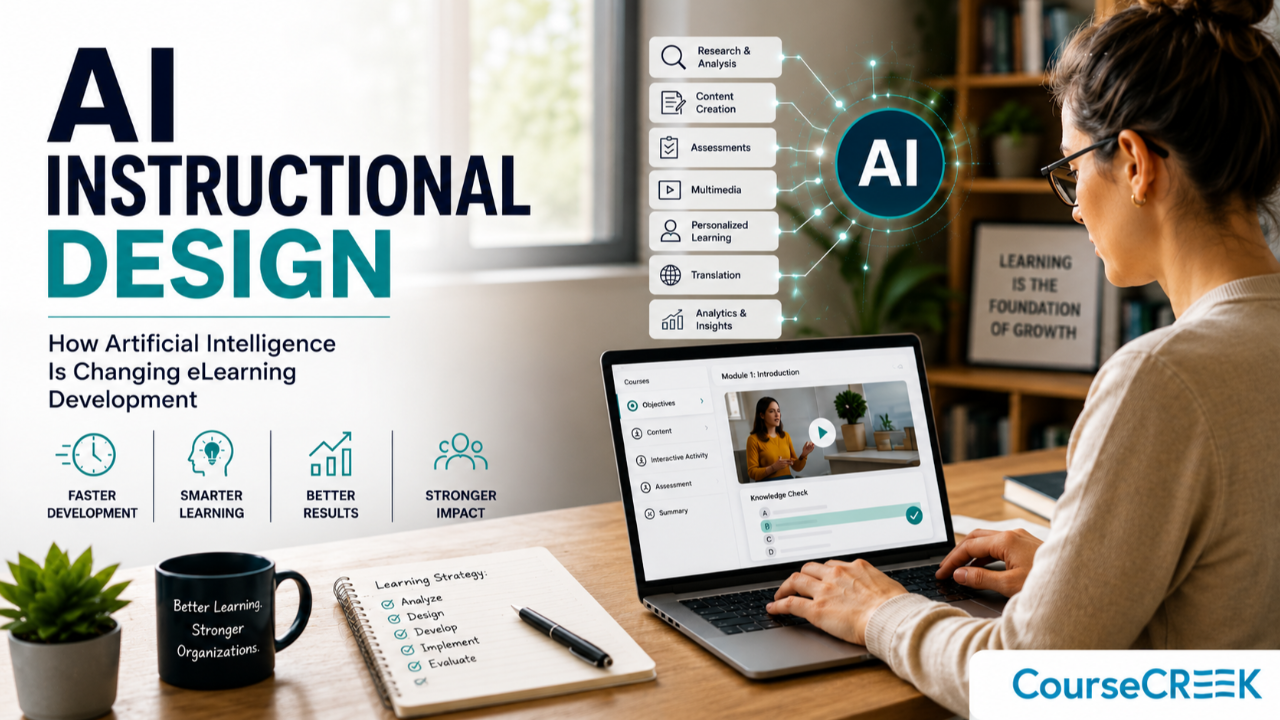
Instructional design has always been about one thing: helping people learn effectively. Whether you're onboarding new employees, training healthcare professionals, educating customers, or building online courses, the goal remains the same. Learning should be engaging, easy to understand, and capable of producing real results.
While that goal hasn't changed, the way learning is created certainly has.
Only a few years ago, developing an eLearning course required significant time and resources. Instructional designers gathered information from subject matter experts, wrote learning objectives, created storyboards, developed assessments, recorded videos, designed graphics, and uploaded everything into a Learning Management System. Even small updates often meant repeating large parts of the process. As businesses grew and industries evolved more quickly, many organizations struggled to keep their training materials current.
Artificial Intelligence is helping solve that challenge.
|
TL;DR Summary
|
Today, AI can organize research, generate first drafts, summarize lengthy documents, recommend learning paths, create quizzes, support multilingual translation, and assist with multimedia production. Tasks that once took days can now be completed in hours, allowing learning teams to deliver high-quality training much faster than before.
Despite these advances, one misconception continues to appear whenever AI enters the conversation. Many people assume Artificial Intelligence will replace instructional designers altogether.
That simply isn't happening.
AI is changing the role of the instructional designer, not eliminating it. Great learning experiences still require human expertise, thoughtful planning, creativity, and a deep understanding of how people learn. Artificial Intelligence provides speed and efficiency, but experienced instructional designers ensure every course is engaging, meaningful, and aligned with business goals.
This combination of technology and human expertise is known as AI Instructional Design, and it is quickly becoming the future of eLearning development.
In this article, we'll explore how AI is transforming instructional design, what it means for organizations investing in online learning, and why partnering with experienced instructional design specialists like CourseCREEK remains one of the smartest decisions a business can make.
What Is AI Instructional Design?
AI Instructional Design is the practice of using Artificial Intelligence to improve the way learning experiences are planned, created, delivered, and maintained. Instead of replacing the traditional instructional design process, AI acts as a powerful assistant that helps learning professionals work more efficiently while maintaining high educational standards.
To understand this better, think about how an architect uses computer software. The software helps create drawings more quickly, but it doesn't replace the architect's knowledge of design, engineering, or functionality. The same principle applies to instructional design.
Artificial Intelligence can analyze information, organize content, generate ideas, and automate repetitive tasks, but it cannot determine the best way to teach a specific audience or ensure learning aligns with business objectives. Those decisions still require experienced instructional designers who understand learning psychology, instructional methodologies, and real-world performance outcomes.
For example, imagine a manufacturing company introducing new workplace safety procedures across multiple facilities. AI can quickly summarize technical manuals, draft learning modules, suggest assessment questions, and even create multilingual versions of the training. However, an instructional designer is still responsible for deciding how the information should be presented, where learners may struggle, what activities will reinforce understanding, and how success should be measured after the training is complete.
This partnership between Artificial Intelligence and instructional designers allows organizations to build better learning experiences in less time while maintaining the quality learners expect.
Rather than asking whether AI will replace instructional designers, organizations should be asking how AI can help instructional designers create more effective learning.
Why AI Is Changing eLearning Development
Businesses today operate in environments where knowledge changes constantly. New technologies emerge every year, regulations evolve, products receive continuous updates, and employee skill requirements continue expanding. Traditional course development often struggles to keep pace with this level of change.
Imagine a healthcare organization that must update compliance training every time regulations change. If every update requires weeks of manual work, employees may continue learning outdated information while the new training is still under development. The same challenge exists for software companies releasing new product features, manufacturers introducing updated procedures, and organizations onboarding employees across multiple locations.
Artificial Intelligence helps reduce these delays.
Instead of beginning every project from scratch, instructional designers can use AI to organize source material, identify key concepts, draft lesson content, generate knowledge checks, and recommend learning structures almost instantly. This dramatically shortens the development cycle while giving learning professionals more time to refine the learner experience.
Another important advantage is consistency. Organizations often develop courses across multiple departments, regions, or business units. AI helps standardize terminology, formatting, learning objectives, and assessments, creating a more consistent experience for learners regardless of where training is delivered.
This doesn't simply improve efficiency. It improves quality by allowing instructional designers to spend less time on repetitive production tasks and more time focusing on learner engagement, practical application, and measurable business outcomes.
As a result, AI is becoming an essential part of modern eLearning development rather than an optional technology.
The Role of the AI Instructional Designer
The responsibilities of an instructional designer are evolving.
In the past, much of an instructional designer's time was spent writing content, formatting materials, creating assessments, and preparing learning assets for publication. While these tasks remain important, Artificial Intelligence now handles many of them much faster.
This shift allows instructional designers to become more strategic.
Instead of spending hours creating a first draft, they spend more time understanding learner needs, collaborating with subject matter experts, designing engaging learning journeys, improving knowledge retention, and measuring business impact.
An AI Instructional Designer doesn't rely on technology to replace expertise. Instead, they know when to use AI and when human judgment is essential.
For example, AI can quickly generate a draft of a customer service training module. An experienced instructional designer then reviews that content, removes unnecessary information, adds realistic scenarios, improves the flow of learning, designs meaningful assessments, and ensures the course reflects the organization's culture and objectives.
The final learning experience is stronger because both AI and human expertise contribute to the process.
Organizations that embrace this collaborative approach consistently develop better learning experiences than those relying entirely on manual development or fully automated content generation.
Artificial Intelligence makes instructional designers more productive.
It doesn't make them less valuable.
How AI Supports Every Stage of Instructional Design
One of the biggest advantages of Artificial Intelligence is that it adds value throughout the entire instructional design process rather than improving just one task. From the first planning meeting to ongoing course maintenance, AI helps learning teams work faster while allowing instructional designers to focus on creating meaningful learning experiences.
The process often begins with research. Instructional designers typically receive large amounts of information from subject matter experts, policy documents, product manuals, or technical guides. Reviewing and organizing this material can take days before course development even begins. AI can summarize lengthy documents, identify recurring themes, organize information into logical topics, and highlight areas that deserve additional attention. Instead of spending hours sorting through content, instructional designers can begin shaping the learner experience much sooner.
Once the research phase is complete, AI can assist with developing course structures and learning objectives. Rather than starting with an empty document, instructional designers receive suggested course outlines that can be refined and improved based on learner needs. This doesn't remove the planning process. It simply provides a stronger starting point that reduces repetitive work while allowing designers to focus on educational quality.
Content development also becomes much more efficient. AI can help generate first drafts of lesson content, knowledge checks, case studies, discussion questions, and assessment ideas. These drafts are never intended to replace professional instructional design. Instead, they give learning teams a foundation that can be reviewed, expanded, and aligned with business objectives. This allows instructional designers to dedicate more time to creating realistic scenarios, improving learner engagement, and ensuring information is presented in a way that is easy to understand and apply.
Artificial Intelligence also supports multimedia production, which has traditionally been one of the most time-consuming parts of eLearning development. AI-powered voiceovers, automatic subtitles, multilingual translations, video enhancement, and AI-assisted editing allow organizations to produce professional learning content much more quickly. Businesses serving global audiences especially benefit because courses can be localized without rebuilding them from the beginning.
Even after a course is published, AI continues adding value. Learning analytics help instructional designers identify lessons where learners struggle, assessments that may be too easy or too difficult, and content that learners frequently revisit. This data allows continuous improvement instead of relying on assumptions. Rather than updating courses once every few years, organizations can make regular improvements based on real learner behavior.
The Business Benefits of AI Instructional Design
The growing interest in AI Instructional Design isn't simply about adopting new technology. Organizations are investing in AI because it helps solve real business challenges.
Perhaps the most obvious benefit is speed. Course development projects that previously required months can now move from planning to launch much faster. Learning teams spend less time on repetitive administrative work and more time delivering value to learners. Faster development also means organizations can respond quickly to changing regulations, product updates, or new business initiatives without delaying employee training.
AI also improves consistency across learning programs. Large organizations often have multiple departments creating courses independently, which can result in inconsistent terminology, branding, assessments, and learner experiences. AI helps standardize many of these elements, creating a more professional and consistent learning environment across the organization.
Another major advantage is scalability. As organizations grow, so do their training requirements. New employees need onboarding, existing employees require ongoing development, partners need certification, and customers expect educational resources that help them succeed. AI makes it possible to support larger audiences without dramatically increasing development time or administrative workload.
Personalization is another area where AI creates significant value. Every learner has different experience levels, responsibilities, and learning preferences. Modern AI-powered learning platforms can recommend content based on learner progress, performance, and job roles, helping individuals focus on the information most relevant to them. This improves engagement while reducing unnecessary training time.
Ultimately, organizations are discovering that AI Instructional Design isn't just about working faster. It's about creating learning experiences that are more engaging, easier to maintain, and better aligned with business goals.
Common Mistakes Organizations Make
While Artificial Intelligence offers tremendous opportunities, it's important to remember that technology alone doesn't create effective learning.
One of the most common mistakes organizations make is relying entirely on AI-generated content without involving experienced instructional designers. Although AI can produce impressive first drafts, it doesn't fully understand organizational culture, learner motivation, business objectives, or the practical challenges learners face in their daily work.
Another mistake is prioritizing speed over quality. AI can certainly accelerate course development, but rushing through instructional design often leads to courses that are difficult to follow, overly technical, or lacking meaningful learner interaction. Faster production should never come at the expense of educational effectiveness.
Some organizations also become distracted by AI features instead of focusing on learner outcomes. The goal isn't to use as many AI tools as possible. The goal is to help people learn more effectively. Every AI capability should support that objective rather than becoming a feature that's added simply because it's available.
Successful organizations understand that Artificial Intelligence works best when guided by experienced learning professionals who know how to combine technology with instructional strategy.
How CourseCREEK Combines AI With Expert Instructional Design
At CourseCREEK, we believe the future of eLearning isn't about replacing instructional designers. It's about giving them better tools to create exceptional learning experiences.
Our Instructional Design team combines decades of educational expertise with modern AI technologies to help organizations build engaging, scalable, and measurable learning programs. Every project begins with understanding your learners, your business objectives, and the outcomes you want to achieve. Only then do we recommend the most appropriate learning strategy and technology.
Our designers apply proven instructional design methodologies, including ADDIE, Bloom's Taxonomy, Backward Design, Agile Learning Design, microlearning, gamification, and adaptive learning. These frameworks ensure every course is structured to maximize learner engagement, improve knowledge retention, and support real business performance.
Artificial Intelligence enhances every stage of this process. We use AI to accelerate research, support curriculum mapping, develop storyboards, generate first drafts, create assessments, assist with multilingual translation, produce AI voiceovers, enhance videos, and streamline course updates. Every AI-generated asset is carefully reviewed and refined by experienced instructional designers to ensure it meets the highest educational standards.
CourseCREEK also provides complete end-to-end eLearning services beyond instructional design. Our team supports LMS selection, LMS migration, implementation, ongoing LMS administration, AI-powered course development, SCORM, xAPI and cmi5 development, healthcare learning solutions, professional video production, and digital marketing. Whether your organization uses LearnWorlds, Docebo, TalentLMS, Absorb LMS, Kajabi, or another leading platform, we help ensure your learning ecosystem supports both your learners and your long-term business goals.
Rather than hiring multiple vendors for strategy, design, implementation, and support, organizations can work with one experienced partner that manages the entire learning journey from concept to launch.
The Future of AI Instructional Design
Artificial Intelligence will continue changing the way learning is designed and delivered, but one thing is becoming increasingly clear. The organizations achieving the greatest success are not replacing instructional designers with AI. They are empowering instructional designers with AI.
Technology provides speed, automation, and efficiency. Human expertise provides strategy, creativity, empathy, and educational insight. Together, they create learning experiences that are more engaging, easier to scale, and better aligned with business objectives than either could achieve alone.
As AI continues to evolve, instructional designers will spend less time producing content and more time solving learning challenges, improving performance, and helping organizations achieve measurable results. This evolution will strengthen the profession rather than diminish it.
Ready to Transform Your eLearning Strategy?
If you're exploring how Artificial Intelligence can improve your employee training, customer education, healthcare learning, or online academy, you don't have to navigate the process alone.
CourseCREEK combines expert instructional design with AI-powered development to help organizations create engaging learning experiences that deliver measurable business results. Whether you need instructional design services, LMS migration, AI-enabled course development, professional video production, or ongoing LMS support, our specialists are ready to help.
During a strategy call, we'll discuss your learning goals, evaluate your current training approach, recommend the right technologies, and outline a practical roadmap for building a scalable learning ecosystem.
Book a strategy call with CourseCREEK today and discover how our instructional design experts can help you create smarter, faster, and more effective eLearning with the power of AI.
10 Lessons About Course Creation, I Had to Learn the Hard Way.
Get the 10-day free email course sent straight to your inbox.
We will never sell your information.


