
DialogueTrainer vs Traditional Training: What Works Better?
May 08, 2026
Most of us have sat through a training session that felt like a waste of time. Slides, a trainer reading notes, and a quick quiz at the end. Then back to work, and two weeks later, most of it is forgotten. That’s exactly where DialogueTrainer steps in, offering a more interactive, conversation-driven approach that replaces passive learning with real engagement.
|
TL;DR Summary
|
Traditional training has been the default for decades, but the data tells a clear story: it does not stick. So when something like an AI-powered, simulation-based method enters the picture, it is worth asking the obvious question, what actually works better?
At CourseCREEK, we are a full-service eLearning partner that helps organizations design, build, and run training programs that actually change behavior. Our team of instructional designers and LMS specialists work with businesses across healthcare, manufacturing, FinTech, and more to turn training investment into real results.
If you are curious to explore a more effective approach, Schedule a Meeting to see how it fits your needs in practice.
In this article, we break it down. We look at how DialogueTrainer compares to traditional training across the factors that matter most to learning and development professionals: retention, scalability, cost, measurement, and real-world readiness.
What Is a DialogueTrainer?
DialogueTrainer is an AI-powered training platform that teaches communication and soft skills through interactive conversation simulations. Instead of watching a video or reading a slide deck, learners practice real conversations with virtual actors.
Those virtual actors respond to every choice the learner makes. They express emotion. They push back. They react the way a real customer, colleague, or patient might. And after each simulation, the platform delivers instant, scored feedback based on what the learner said and how they said it.
DialogueTrainer was co-developed with Utrecht University and is grounded in behavioral science. It has been used to improve the communication skills of more than 60,000 people across industries including healthcare, finance, manufacturing, and education.
The platform integrates with most LMS environments, including LatitudeLearning. That means it can slot into your existing training infrastructure without disruption.
What Is Traditional Training?
Traditional training refers to the conventional methods most organizations have relied on for years. Think:
- Instructor-led classroom sessions
- Slide-based presentations
- Printed manuals and handouts
- In-person role-play exercises
- Recorded video lectures
These methods are familiar. They are easy to organize. And for certain types of content, such as compliance briefings or technical knowledge transfer, they can work well.
However, for communication skills and soft skills development, traditional training has a significant weakness. It tells people what to do. It does not give them enough practice actually doing it.
The Retention Problem With Traditional Training
Here is the core issue with traditional training: people forget most of it very quickly.
Research consistently shows that retention rates for traditional classroom learning sit at just 8-10% after one week. Learners might pass a test on the day. But by the time they need to apply that knowledge in a real conversation, most of it is gone.
By contrast, eLearning and active practice methods show retention rates of 25-60%. That is a dramatic difference. And when you add scenario-based practice, which is what DialogueTrainer is built on, retention improves further because learners are encoding knowledge through experience, not just exposure.
Furthermore, studies show that learners who practice through simulation feel up to 275% more confident applying their skills in the real world. Confidence is not a soft benefit. In customer service, sales, and leadership roles, it directly affects outcomes.
DialogueTrainer vs Traditional Training: Side by Side
Here is how the two approaches compare across the factors that matter most:
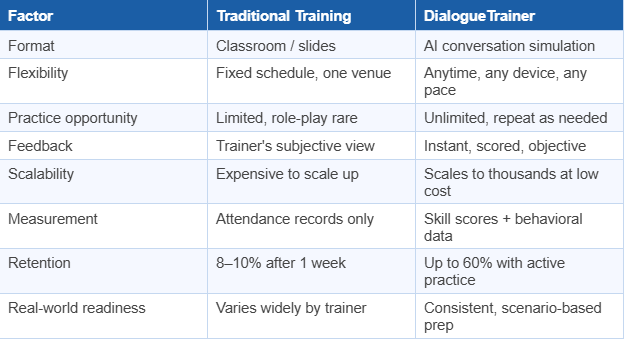
The table above is not meant to suggest that traditional training has no value. It does, especially for knowledge transfer, onboarding, and compliance. But for communication skills, the comparison is hard to ignore.
Where DialogueTrainer Has a Clear Edge
There are three specific areas where DialogueTrainer stands out clearly over traditional methods.
1. Unlimited, Safe Practice
In a traditional training session, a learner might get one or two chances to practice a difficult conversation. That is rarely enough for the skill to stick.
With DialogueTrainer, learners can practice the same scenario as many times as they want. They can try different approaches. They can make mistakes without real-world consequences. They can build confidence before they ever face the situation for real.
This is the same principle behind flight simulators. Pilots do not learn to handle emergencies by reading about them. They practice in a safe environment until the right responses become automatic. DialogueTrainer brings that same logic to communication training.
2. Objective, Measurable Feedback
Traditional training feedback depends heavily on the trainer. It is subjective, inconsistent, and often delayed. One trainer might focus on tone. Another might focus on content. The learner gets a different message depending on who is in the room.
DialogueTrainer changes that. Every simulation produces a score. Managers and L&D teams get structured data on learner performance across the entire workforce. They can see exactly where communication skills are strong and where the gaps are.
In addition, that data can feed directly into coaching decisions. If a service team consistently struggles with complaint handling, you know exactly where to focus the next training cycle.
3. Scalability Without Proportional Cost
Scaling traditional training is expensive. Every new location, every new cohort, every new hire requires a trainer, a venue, and time. Costs rise in direct proportion to the number of learners.
DialogueTrainer breaks that relationship. Once a simulation is built, it can be deployed to thousands of learners simultaneously, at any time, from any device, in any location. The marginal cost of adding the next learner is close to zero.
For organizations with distributed teams, partner networks, or high staff turnover, this scalability is a game-changer.
When Traditional Training Still Makes Sense
To be fair, traditional training is not without merit. There are situations where it still performs well.
- Initial onboarding sessions that require face-to-face relationship building
- Complex technical knowledge transfer that benefits from live Q&A
- Compliance training where a record of in-person attendance is required
- Leadership workshops that depend on group dynamics and peer interaction
The most effective training programs do not choose between DialogueTrainer and traditional methods. They combine both. Traditional training sets the context and builds the knowledge base. DialogueTrainer provides the practice environment where that knowledge becomes skill.
How CourseCREEK Helps You Get the Most From DialogueTrainer
About CourseCREEK | Visit CourseCREEK
CourseCREEK is a full-service eLearning partner that helps organizations build, launch, and grow their training programs. Their team includes certified instructional designers, LMS specialists, and marketing strategists who specialize in extended enterprise and professional skills training.
Knowing that DialogueTrainer is powerful is one thing. Knowing how to deploy it effectively inside your organization is another.
That is where CourseCREEK comes in. As a specialist eLearning partner, CourseCREEK works with L&D teams and training managers to design, build, and launch conversation simulations on platforms like DialogueTrainer. Their instructional designers understand how to map realistic workplace scenarios to learning objectives, so every simulation your team practices is directly tied to business outcomes.
Furthermore, CourseCREEK provides ongoing LMS administration, content updates, and off-the-shelf course libraries for clients who want to move fast. Whether you are starting from scratch or looking to upgrade a program you already have, CourseCREEK removes the guesswork and gives you a full team behind your training investment.
So, Which One Works Better?
If the question is about pure effectiveness for communication and soft skills training, DialogueTrainer wins on every measurable dimension. Better retention. Better scalability. Better measurement. Better real-world readiness.
But the smarter question is not which one to choose. It is how to use both together. Traditional training provides the foundation. DialogueTrainer provides the practice. Together, they create a training program that actually changes behavior, not just one that gets completed.
For L&D teams looking to move in this direction, the starting point is simple. Identify the communication skills that matter most in your organization. Map them to realistic scenarios. Then give your people the space to practice, safely, repeatedly, and with feedback they can act on.
If you want help building that kind of program, CourseCREEK is a good place to start. Our team specializes in exactly this kind of work, and they know how to get results.
10 Lessons About Course Creation, I Had to Learn the Hard Way.
Get the 10-day free email course sent straight to your inbox.
We will never sell your information.


