
The Future of AI Learning Platforms: What to Expect in 2026
Jul 17, 2026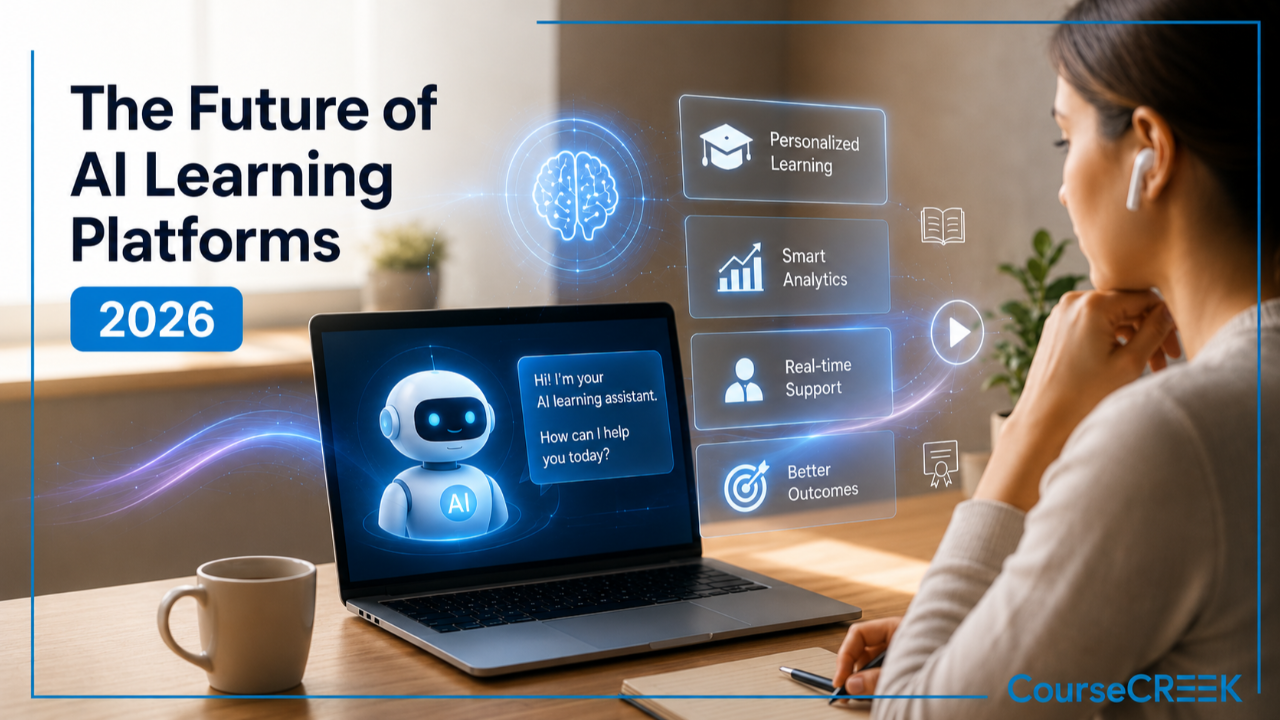
Artificial Intelligence is no longer a futuristic concept in education. It has become part of how people learn, how businesses train employees, and how organizations deliver knowledge at scale. Over the last few years, AI has evolved from a simple productivity tool into a powerful learning companion that is reshaping the entire eLearning industry.
Think back to how online learning worked just a few years ago. Most Learning Management Systems were little more than digital libraries. Learners logged in, watched videos, completed quizzes, downloaded PDFs, and eventually earned a certificate. Every learner followed the same path regardless of their experience, job role, or learning style.
While this approach worked, it had clear limitations. Some learners moved too quickly through content they already understood, while others struggled to keep up. Course creators spent months building training programs, only to update them again as industries evolved. Organizations invested heavily in employee training but often had little visibility into whether that training actually improved performance.
Today, expectations are very different.
|
TL;DR Summary
|
Businesses need training that keeps pace with rapid technological change. Employees expect learning experiences that are engaging, flexible, and relevant to their daily work. Customers want interactive education instead of static content. Coaches and consultants want to scale their expertise without sacrificing quality.
This is exactly where AI Learning Platforms are changing the game.
Rather than simply delivering content, modern AI Learning Platforms are becoming intelligent learning ecosystems. They can personalize lessons, recommend what learners should study next, identify knowledge gaps, automate administrative tasks, and provide instant support throughout the learning journey.
The result is better engagement, faster learning, and measurable business outcomes.
As we move through 2026, AI will become an essential part of every successful learning strategy. Organizations that embrace these technologies today will be better prepared to train employees, educate customers, and stay competitive in an increasingly digital world.
In this article, we'll explore how AI Learning Platforms are evolving, the biggest trends shaping their future, and how organizations can prepare by building smarter learning experiences.
Why AI Learning Platforms Are Growing So Fast
There is one simple reason AI Learning Platforms are growing so quickly.
The world is changing faster than people can learn.
Every industry is evolving. Healthcare organizations must keep staff updated on changing regulations. Manufacturers introduce new equipment every year. Financial institutions regularly update compliance requirements. Software companies release new products and features almost weekly.
The pace of change means learning can no longer happen once a year or only during employee onboarding. It has become an ongoing process.
Traditional training methods struggle to keep up.
Many organizations still rely on classroom sessions, lengthy manuals, or outdated online courses. While these methods still have their place, they often require significant time to create, are difficult to update, and rarely provide a personalized experience.
Artificial Intelligence helps solve these challenges.
Instead of treating every learner the same, AI adapts training to individual needs. It analyzes learner behavior, identifies strengths and weaknesses, recommends relevant content, and helps people learn more efficiently.
This makes learning faster without making it more complicated.
For organizations, this means employees spend less time searching for information and more time applying what they have learned.
For learners, it creates a far more engaging experience because the content feels relevant instead of repetitive.
Another major reason AI Learning Platforms are growing is the increasing demand for continuous upskilling.
Employers no longer hire people expecting their existing skills to last for an entire career. Technology continues to reshape jobs, creating a need for ongoing professional development.
Instead of asking employees to complete occasional training sessions, organizations are creating cultures of continuous learning where education becomes part of everyday work.
AI makes this possible by delivering the right content at the right time.
Learning Is No Longer One Size Fits All
One of the biggest changes happening in eLearning is the move away from standardized education.
Imagine two employees joining the same company.
One has ten years of industry experience.
The other is completely new.
Traditional learning platforms often require both employees to complete the exact same training.
This wastes time for experienced employees while overwhelming beginners.
AI changes that completely.
Modern AI Learning Platforms can understand where each learner is starting from.
They analyze assessment results, previous learning history, job responsibilities, and learning behavior to create personalized learning paths.
Instead of following a fixed curriculum, learners receive recommendations based on what they actually need.
Someone who already understands the fundamentals can move directly into advanced topics.
Someone who needs additional support receives more examples, extra practice, and personalized guidance before progressing.
This creates a better experience for everyone involved.
More importantly, it improves knowledge retention because learners stay engaged throughout the process.
Personalized learning is quickly becoming one of the biggest expectations in modern education, and AI makes it possible at a scale that traditional training never could.
AI Is Becoming a Learning Partner
One of the biggest misconceptions about Artificial Intelligence is that it replaces instructors.
In reality, AI works best when it supports human expertise rather than replacing it.
Think about how people learn today.
If someone has a question while taking an online course, they often need to pause their learning, search Google, browse forums, or wait for an instructor to respond.
This interrupts the learning process.
AI changes that experience.
Instead of leaving the course, learners can ask questions directly within the platform and receive immediate explanations.
If they struggle with a concept, AI can explain it in a different way.
If they perform poorly on an assessment, AI can recommend additional resources before allowing them to continue.
This creates a learning experience that feels much more interactive.
Rather than simply delivering information, the platform becomes an active learning partner.
That doesn't reduce the importance of instructors.
Instead, it allows instructors to spend more time mentoring learners, facilitating discussions, and creating meaningful educational experiences while AI handles repetitive support tasks.
This balance between human expertise and intelligent technology is shaping the future of online learning.
Businesses Are Looking Beyond Certificates
For many years, success in online learning was measured by one thing.
Course completion.
If someone completed every lesson and passed the final quiz, they received a certificate.
While certificates remain valuable, organizations are becoming much more interested in real skills.
Can employees actually perform their jobs better?
Can sales representatives handle customer conversations more effectively?
Can healthcare professionals confidently follow updated compliance procedures?
Can managers lead teams more successfully?
These questions matter far more than simply knowing whether someone watched every video.
Modern AI Learning Platforms help answer these questions through adaptive assessments, practical exercises, interactive simulations, and performance tracking.
Instead of measuring attendance, organizations can measure competency.
This shift from course completion to skill development is one of the biggest changes happening across corporate learning today.
It allows businesses to see a clearer return on their investment while giving learners confidence that they are developing practical abilities they can apply immediately.
The Biggest AI Learning Trends Defining 2026
Artificial Intelligence has already changed how we search for information, create content, and automate everyday tasks. In 2026, it is transforming learning in much the same way. Instead of simply adding AI features to existing platforms, developers are rethinking how learning should work from the ground up.
The result is a new generation of AI Learning Platforms that are smarter, more interactive, and focused on helping people achieve real outcomes rather than simply completing courses.
AI Tutors Are Becoming Part of Every Learning Platform
One of the most noticeable changes is the rise of AI tutors.
Not long ago, learners had to wait hours or even days for answers to their questions. Today, AI can provide guidance instantly.
Imagine an employee taking a cybersecurity course. They reach a topic they don't fully understand. Instead of leaving the course to search online or emailing an instructor, they simply ask the AI tutor for help.
Within seconds, the AI explains the concept using simpler language. If that explanation still isn't clear, it can provide another example, generate a short quiz, or recommend additional learning materials.
This doesn't replace instructors. It simply removes the frustration of waiting for help and allows learning to continue without interruption.
For businesses, this means employees stay productive. For learners, it creates a smoother and more enjoyable learning experience.
Learning Will Adapt to Every Individual
Traditional learning platforms assume everyone learns the same way.
They don't.
Some people prefer reading.
Others understand concepts faster through videos.
Some need extra practice before moving forward, while others are ready for advanced topics immediately.
AI recognizes these differences automatically.
Instead of creating one learning path for everyone, modern platforms adjust content based on each learner's progress, assessment results, job role, and learning behavior.
For example, a new sales representative may receive additional lessons on product knowledge before moving into negotiation techniques. Meanwhile, an experienced salesperson can skip the basics and focus on advanced strategies.
This level of personalization keeps learners engaged because they spend time learning what actually matters to them.
Learning Will Become More Interactive
Online learning has often been criticized for being passive.
Watching videos for hours without interaction isn't the most effective way to learn.
AI is helping change that.
Instead of simply consuming information, learners are becoming active participants.
Modern platforms are introducing realistic scenarios, role-playing exercises, interactive conversations, and instant feedback throughout the learning experience.
A healthcare professional might practice patient communication in a simulated environment.
A customer support representative could handle realistic customer conversations before speaking with actual clients.
A manager may work through leadership challenges using AI-generated business scenarios.
Learning becomes something people experience rather than simply watch.
AI Is Making Course Development Faster
Creating high-quality eLearning has traditionally required months of planning, writing, reviewing, recording, and editing.
AI is dramatically reducing that timeline.
It can help instructional designers organize content, generate first drafts, write assessments, suggest learning objectives, and even assist with voiceovers, translations, and video production.
This doesn't eliminate the need for instructional designers.
Quite the opposite.
Experienced designers remain essential for ensuring courses are engaging, accurate, and aligned with business objectives.
AI simply removes many repetitive tasks, allowing learning teams to focus on creativity and learner experience instead of manual production.
Organizations can launch training programs much faster while maintaining high quality.
Businesses Want Smarter Learning Analytics
One of the biggest frustrations for Learning and Development teams has always been proving whether training actually works.
Did employees learn anything?
Did performance improve?
Was the investment worthwhile?
Traditional reports often answer only one question.
"Did the learner finish the course?"
AI provides a much clearer picture.
Modern learning platforms can identify which topics learners struggle with, where people lose interest, which lessons produce the best outcomes, and which departments require additional support.
Managers no longer have to rely on assumptions.
Instead, they can make decisions using real learning data.
This helps organizations continuously improve both their training programs and overall business performance.
Continuous Learning Is Becoming the New Normal
There was a time when employees attended training once or twice a year.
That approach no longer works.
Technology changes too quickly.
New regulations appear regularly.
Customer expectations continue evolving.
Learning has become part of everyday work.
Rather than waiting for annual training sessions, AI continuously recommends new learning opportunities based on changing business needs and employee performance.
Someone moving into a leadership position may automatically receive management training.
A healthcare professional may receive updated compliance training as regulations change.
A sales team may receive product education immediately after a new feature launches.
Learning becomes ongoing instead of occasional.
AI Helps Organizations Scale Training
As businesses grow, training becomes more complex.
New employees need onboarding.
Existing employees require ongoing development.
Partners need product education.
Customers need training resources.
Managing all of this manually becomes increasingly difficult.
AI allows organizations to deliver personalized learning to thousands of people simultaneously without increasing administrative workload.
Whether a company has fifty employees or fifty thousand, AI helps maintain consistency while still providing individualized learning experiences.
This scalability is one of the biggest reasons organizations are investing heavily in AI Learning Platforms.
Human Expertise Still Matters
With so much discussion about AI, it's easy to assume technology will replace educators.
The opposite is happening.
AI is exceptionally good at processing information, identifying patterns, and automating repetitive tasks.
Humans are still far better at mentoring, inspiring, coaching, solving complex problems, and building meaningful relationships.
The most successful organizations understand this balance.
They use AI to make learning more efficient while allowing subject matter experts, instructors, and Learning & Development professionals to focus on the areas where human expertise creates the greatest value.
The future of education isn't AI versus people.
It's AI working alongside people to create learning experiences that are more engaging, more effective, and easier to scale.
AI Is Raising Expectations
Perhaps the biggest trend isn't technological at all.
It's the expectations learners now have.
People expect personalized recommendations because they experience them every day on streaming platforms and online shopping websites.
They expect instant answers because conversational AI has become part of everyday life.
They expect learning to be flexible because they consume information whenever and wherever they choose.
Organizations that continue relying on outdated training methods will increasingly struggle to keep learners engaged.
Those that embrace AI-powered learning will be better positioned to educate employees, customers, and partners in a way that feels modern, relevant, and valuable.
By 2026, AI won't simply be another feature inside a Learning Management System.
For many organizations, it will become the foundation of how learning is designed, delivered, and continuously improved.
Preparing Your Organization for the Future of AI Learning
The rapid growth of AI Learning Platforms has created plenty of excitement, but it has also created confusion.
Many organizations believe that adopting AI simply means adding an AI chatbot to their Learning Management System or using AI to generate course content. While those tools are useful, they represent only a small part of what AI-powered learning can achieve.
The organizations seeing the greatest results are taking a much broader approach. They are rethinking how they design learning experiences, how they engage learners, and how they measure success.
Instead of asking, "How can we use AI?" they are asking, "How can we create better learning experiences with AI?"
That shift in thinking makes all the difference.
A successful AI Learning Platform starts with a clear strategy. Before selecting technology, organizations need to understand who they are training, what business goals they want to achieve, and how learning will support those goals. Whether the objective is reducing onboarding time, improving compliance, increasing customer adoption, or generating revenue from online courses, every decision should align with measurable outcomes.
The technology should support your strategy, not define it.
Many organizations also underestimate the importance of instructional design. Even the most advanced AI cannot fix poorly structured content or confusing learning experiences. AI can personalize learning, automate repetitive tasks, and provide intelligent recommendations, but learners still need engaging content built around proven educational principles.
This is why experienced instructional designers remain essential. They understand how adults learn, how to keep learners engaged, and how to turn complex information into practical knowledge that people can apply immediately.
The future belongs to organizations that combine great instructional design with intelligent technology.
Why Choosing the Right eLearning Partner Matters
Building a future-ready AI Learning Platform is rarely a one-person project.
It requires expertise in learning strategy, instructional design, content development, Learning Management Systems, AI implementation, automation, integrations, marketing, and ongoing support.
Trying to manage every part internally can quickly become overwhelming, especially when technology continues evolving so rapidly.
That's why many organizations choose to work with an experienced eLearning partner.
The right partner doesn't simply build courses. They help you develop a long-term learning strategy, recommend the best technology, create engaging content, implement your LMS, train your team, and continue supporting you as your business grows.
Most importantly, they help you avoid expensive mistakes.
Choosing the wrong platform, poor instructional design, or ineffective learner journeys can cost far more than investing in experienced specialists from the beginning.
How CourseCREEK Helps Organizations Build Future-Ready Learning Platforms
At CourseCREEK, we believe technology should make learning better, not more complicated.
Our team combines instructional design expertise, AI innovation, LMS implementation, and digital marketing to help organizations create learning experiences that produce measurable business results.
Rather than offering isolated services, we provide an end-to-end solution that supports every stage of your learning journey.
It Starts with Strategy
Every successful learning platform begins with understanding your business.
Before recommending technology, we work closely with your team to understand your goals, your learners, your existing systems, and the outcomes you want to achieve.
Whether you're launching a customer academy, training employees, educating healthcare professionals, or monetizing your expertise, we develop a roadmap designed specifically for your organization.
This strategic foundation helps ensure every decision supports your long-term objectives.
We Design Learning People Actually Enjoy
Creating great eLearning involves much more than writing content.
Our instructional designers build engaging learning experiences using proven methodologies such as ADDIE, Bloom's Taxonomy, microlearning, gamification, and adaptive learning strategies.
We also leverage AI to accelerate content production without sacrificing quality.
From storyboards and assessments to interactive learning activities, professional video production, multilingual translations, AI voiceovers, and persuasive copywriting, every course is designed to maximize learner engagement and knowledge retention.
The result is training that doesn't just look professional. It delivers measurable learning outcomes.
We Build and Optimize Your LMS
Once your learning content is ready, our team handles implementation.
CourseCREEK works with many of the world's leading Learning Management Systems, including LearnWorlds, Docebo, Absorb LMS, TalentLMS, Kajabi, Canvas, FlowSparks, Latitude Learning, MyQuest, and many others.
Whether you're migrating from an existing platform or launching a completely new learning environment, we ensure the transition is smooth and secure.
Our LMS services include migration, implementation, integrations, automation, AI-powered learning features, mobile-first experiences, SCORM deployment, and ongoing LMS support.
For organizations in highly regulated industries such as healthcare, we also develop learning environments that support compliance while delivering exceptional learner experiences.
We Help You Grow After Launch
Building a great learning platform is only the beginning.
People still need to discover your courses.
That's why CourseCREEK also provides digital marketing and lead generation services that help organizations attract the right audience.
Our marketing specialists support clients with search engine optimization, Google Ads, Meta advertising, LinkedIn lead generation, email outreach, CRM automation, and conversion-focused sales funnels.
Instead of working with multiple agencies, you have one experienced team managing everything from strategy and course development to implementation and growth.
AI Is Powerful. Strategy Makes It Valuable.
Artificial Intelligence will continue changing education for years to come.
New tools will emerge.
Learning experiences will become even more personalized.
Automation will become smarter.
Analytics will become more detailed.
But one thing is unlikely to change.
Organizations that combine AI with thoughtful strategy, strong instructional design, and the right technology will consistently achieve better learning outcomes than those relying on technology alone.
AI is a powerful tool.
It becomes truly valuable when it's implemented with purpose.
The Future Starts Today
The future of AI Learning Platforms isn't five years away.
It's already here.
Organizations across healthcare, corporate training, professional associations, higher education, coaching, and enterprise learning are already using AI to deliver more engaging, personalized, and scalable learning experiences.
The question isn't whether AI will become part of your learning strategy.
The question is whether you'll be leading the change or trying to catch up later.
By investing in the right platform, the right strategy, and the right implementation partner today, you'll build a learning ecosystem that continues creating value long into the future.
Ready to Build an AI-Powered Learning Platform?
Whether you're planning an LMS migration, developing online courses, improving employee training, modernizing healthcare education, or launching a new learning business, CourseCREEK can help.
From strategy and instructional design to AI-powered course development, LMS implementation, ongoing support, and lead generation, our specialists become an extension of your team.
With more than 30 years of eLearning experience, 97+ organizations served, 21+ certifications across leading LMS platforms, and a 100% five-star TrustPilot rating, we're committed to helping organizations create learning experiences that deliver real results.
Book a strategy call with CourseCREEK today. We'll help you build an AI-powered learning platform that engages learners, supports your business goals, and prepares your organization for the future of education.
10 Lessons About Course Creation, I Had to Learn the Hard Way.
Get the 10-day free email course sent straight to your inbox.
We will never sell your information.


